Why You're Making the Biggest Decisions of Your Life Blind And What to Do About It?
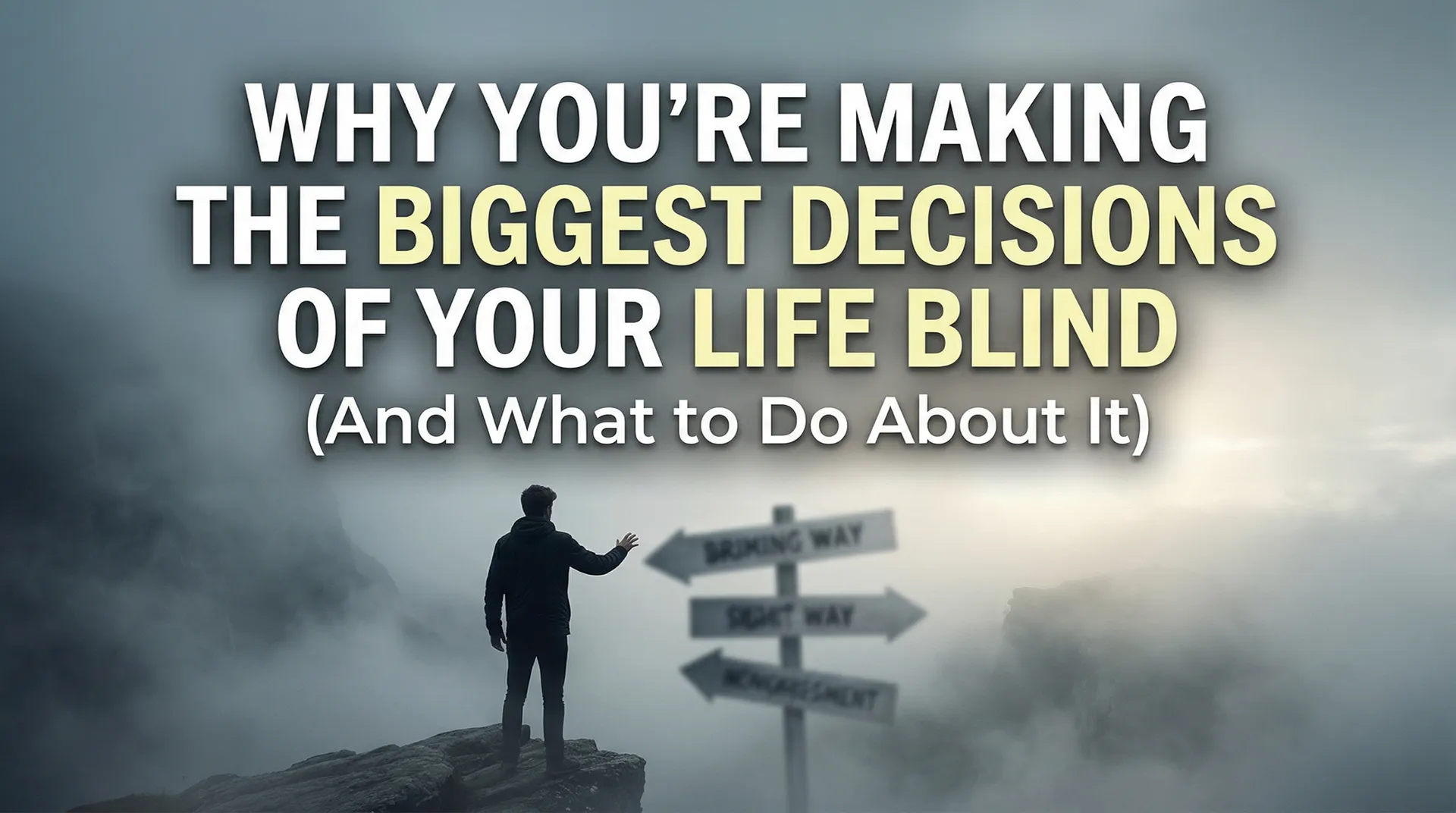
Here's something nobody tells you when you're standing at a life crossroads: you are almost certainly making your decision with worse information than you'd use to buy a car.
Before buying a car, most of us read reviews, compare reliability data, check resale values, and look at what other people paid. We crowd-source the wisdom of thousands of strangers because we know our own experience is too limited to make a good call alone.
But when it comes to the decisions that actually define our lives - whether to leave a stable job for a startup, whether to relocate for love, whether to drop out and go independent - we tend to rely on three things: gut feelings, advice from a handful of people who know us, and generic think-pieces that were written to get clicks rather than help you choose.
That's the gap. And it's enormous.
The decisions that shape you most are the ones you're least equipped to make
Research on life decisions paints a picture that should make all of us pause. When researchers at the University of Technology Sydney asked 657 Americans to identify the ten biggest decisions of their lives, they found that the most significant choices tended to cluster around romance, family, education, and career - exactly the areas where we have the least comparable experience and the most emotional static.
Part of what makes these decisions so hard is that they're almost by definition unrepeatable. You don't get to try leaving your career for a startup three or four times until you work out the method. There's no practice round. And because there's no practice round, you can't learn from your own mistakes in the way you might in a lower-stakes domain.
So where does that leave you? Relying on the experience of others. Which sounds sensible, until you examine the quality of that experience.
The survivorship bias problem nobody talks about in life advice
Here's a thought experiment. You're considering quitting your corporate job to launch a startup. You ask around. The people who respond most enthusiastically to your idea are the ones who did it - and it worked. The ones for whom it didn't work largely aren't in your orbit anymore. They're back in corporate jobs, a bit quieter about the whole thing, not the people being asked to speak on panels or write Medium articles about the leap.
This is survivorship bias - a well-documented cognitive trap where we draw conclusions from only the visible survivors, completely overlooking the far larger population of people who took the same path and didn't make it. In World War II, the military initially planned to armour the parts of returning planes that showed the most bullet holes. It took statistician Abraham Wald to point out the obvious flaw: the planes that had been hit in those spots had still returned. It was the planes that didn't come back that showed you where the real vulnerabilities were.
The same logic applies to life decisions. The advice ecosystem - podcasts, books, keynote speeches, viral LinkedIn posts - is almost entirely built on survivor testimony. It feels like data. It isn't. It's an anecdote dressed up as insight, and it systematically overstates the probability of good outcomes for any given choice.
"The most dangerous kind of advice is advice from people who were lucky and believe they were skilled."
The result? You overestimate your chances, underestimate the risk, and potentially make a decision that looks exactly like the success stories and ends up in a completely different place.
The six decisions people most often regret - and what the data says
The research on life regret offers a useful corrective. A nationally representative study of 270 Americans asked people to describe their most significant life regret. The top six categories, in order, were: romance (19.3%), family (16.9%), education (14.0%), career (13.8%), finance (9.9%), and parenting (9.0%).
What's striking about this list isn't just the categories - it's the pattern underneath them. The most enduring regrets, researchers found, weren't regrets about things that went wrong after a good-faith decision. They were regrets about inaction. About the paths not taken. About times people chose the safe option when something in them was pushing toward something braver.
That's a genuinely useful signal, but it's also incomplete. "Regret inaction more than action" is decent general advice, but it doesn't tell you whether your specific startup idea in this specific market at this specific moment in your life is likely to work. For that, you need something more granular.
You need outcome data. Not the story. The outcome.
Why gut feelings and friend-advice keep letting us down
Gut feelings have their place. There's genuine research supporting the idea that intuition - particularly in domains where we have real experience - can be a reliable guide. The problem is that most of us are using gut feelings in exactly the domains where we have the least experience. "Does this relationship feel right?" might be a reasonable question to put to your intuition. "Is this the right time to leave my job for a startup?" probably isn't, unless you've done it several times before.
Friend advice has a different problem. The people close to us know us well, which ought to make their advice more relevant. But it also means they're deeply invested in our wellbeing in ways that bias their recommendations. People who love you don't want to see you fail. People who are happy in their stable jobs might - without fully realising it - steer you toward the choice that feels safer because it reduces their own vicarious anxiety. People who took the leap and succeeded want you to experience what they experienced.
None of this is malicious. But it means that the most accessible sources of decision-making guidance are systematically biased in ways that are almost impossible to correct for in real time.
What actually makes a decision good or regrettable
Research by Max Planck Institute scientists, published in American Psychologist, identified five key dimensions that make life decisions transformative - and therefore hard. These are: conflicting values that can't easily be compared, potential for self-identity to change as a result, uncertainty about how the outcome will actually feel, irreversibility, and social complexity. Most of the decisions we agonise over score high on several of these dimensions at once.
Interestingly, the quality of a decision - whether you'll be satisfied with it later - correlates strongly with whether you had good reasons for it at the time, not just with whether it worked out. People who make a decision they can justify, with the information available to them, tend to cope better with bad outcomes than people who made the same decision impulsively. This is important because it shifts the goal: you're not trying to predict the future perfectly (impossible). You're trying to make the best possible call with the best possible information.
That's where real, structured outcome data changes the equation entirely.
The missing infrastructure: what collective hindsight actually looks like
There is an enormous library of human experience sitting in people's heads. Millions of people have already walked the specific paths you're weighing up - left the stable career for the startup, relocated for the relationship, made the safe choice or the risky one. They've lived with the consequences, not just for six months but for five years, ten years, a decade or more. They know things about how those decisions played out that they couldn't have known at the time.
Until recently, that collective wisdom was essentially invisible. It existed in fragments - in subreddit threads and private conversations, in the things people say at dinner years later. There was no systematic way to find it, aggregate it, or compare it against your own situation.
"The best time to have had this data was before the decision. The second best time is now."
The Regret Index exists to change that. By collecting structured, anonymised outcome data from people who have already made the decisions you're facing - and following up with them over time - it builds a picture of what these choices actually look like in practice. Not the survivor stories. Not the worst-case cautionary tales. The full distribution: the people who are glad they did it, the people who are neutral, the people who wish they hadn't, and everything in between.
What does that look like in practice? It means that when you're staring down the question of whether to leave your job for a startup, you can look at what people who actually did it reported at the six-month, two-year, and five-year marks. You can filter by context - industry, life stage, financial cushion, whether they had a co-founder. You can see the regret curve, not just the headline result. You can find the nuance that no anecdote can give you.
Why longitudinal data is the thing that changes everything
One of the most consistent findings in decision research is that how we evaluate a decision changes dramatically over time. The job that felt like a disaster at six months sometimes looks like the best thing that ever happened to you at five years. The relationship you were certain about in year one might look very different in year four. The gap between short-term and long-term satisfaction is one of the most reliable patterns in the entire literature.
This is why most decision-support resources are fundamentally limited. A Reddit post from someone two months into their career change isn't the same as a reflection from someone who's eight years on. Both are useful data points - but they're very different data points, and without knowing the timeframe, you can't interpret the signal correctly.
Longitudinal tracking - following the same cohort of decision-makers over years, not just asking for a snapshot - is how you start to see the real picture. The Regret Curve isn't a straight line. It dips and rises and plateaus in ways that matter enormously if you're trying to understand what a given decision will actually feel like to live with.
What to do right now if you're facing a big decision
Whether or not you use a tool like The Regret Index, there are things you can do to make your next big decision better than average:
Actively seek out failure stories. The advice ecosystem is tilted toward success. Deliberately hunt for people who took the path you're considering and didn't get the outcome they wanted. Their experience is at least as informative as the winners'.
Ask for outcomes, not opinions. "What do you think I should do?" elicits the biases of the person you're asking. "What actually happened for you?" or "What do you know now that you didn't know then?" gets you closer to data.
Consider the full timeframe. How does this decision look at six months? At three years? At ten? Many decisions that feel catastrophic in the short term look very different with distance - and vice versa.
Write down your reasons. Whatever you decide, document why. Research suggests that people who can articulate clear, defensible reasons for a decision cope significantly better with bad outcomes than those who can't.
Find the base rate. Before deciding, try to find out how often outcomes like the one you're hoping for actually materialise. Not from the people who got there, but from everyone who tried.
The decision you're making isn't actually unique
This is, depending on your perspective, either deflating or incredibly liberating: the crossroads you're standing at right now has almost certainly been stood at by thousands of people before you. People who were in roughly similar situations, facing roughly similar trade-offs, with roughly similar things at stake.
Some of them flourished. Some of them struggled. The pattern of why is the thing that matters - and that pattern is knowable, if you have the right data.
For too long, we've treated the biggest decisions in life as fundamentally private, intuitive, and inarticulate - things you just have to feel your way through. That's partly true. But it doesn't mean we can't do better. We can give people access to the collective experience of everyone who has walked the path before them, structured in a way that actually helps rather than just confirms what they already wanted to believe.
That's what The Regret Index is building. Not an algorithm that tells you what to do. Not a set of rules that guarantee good outcomes. But honest, longitudinal, survivorship-bias-corrected data about what the decisions that define a life actually look like - including the ones that didn't go to plan.
Have you already made a decision you'd like to add to the archive? Your outcome - whatever it was - helps someone else who's standing where you once stood. Submit your decision at regretindex.me
Written for The Regret Index community. The data referenced in this article draws on published research from the University of Technology Sydney, the Max Planck Institute for Human Development, and independent researchers in judgment and decision-making science.